
Roy Heidelberg Delivers Sternberg Lecture on AI and Governance
March 04, 2026
In this year's Sternberg Lecture, Roy Heidelberg explored how AI fits into centuries of institutional automation. The real question isn't whether machines can think, it's what happens when institutions are built to think like machines.
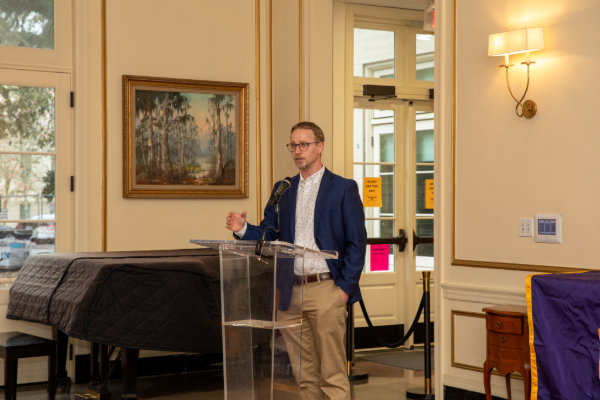
Dr. Roy Heidelberg, giving the annual Sternberg lecture on March 4, 2026.
The Roger Hadfield Ogden Honors College at LSU has celebrated Dr. Roy Heidelberg of the E.J. Ourso College of Business as the 2025-26 Erich and Lea Sternberg Honors Professor, the highest award conferred to faculty by the Ogden Honors College.
Established by Lea Sternberg in 1996, the professorship recognizes exceptional faculty contributions to the Honors College community through distinguished scholarship and transformative teaching.
Every year, the chosen Sternberg Professor delivers a formal academic lecture to the
Honors College community. Heidelberg's lecture, titled "Nobody's Decision or: How
We Learned to Stop Thinking and Love the Machine," provided a reinterpretation of
artificial intelligence within historical and institutional contexts.
About Dr. Roy Heidelberg
Roy Heidelberg serves as Chair of the Department of Public Administration in the E.J. Ourso College of Business. He joined LSU in 2012 as an assistant professor after completing his PhD at the Glenn College of The Ohio State University. His scholarship bridges political theory, philosophy, and governance, exploring the conceptual foundations of public administration and questions of statecraft.
His research interests span public policy, state theory, bureaucracy, and an increasingly urgent topic: government and artificial intelligence. In the Honors College, he has taught "Honors 2000: Critical Analysis: Louisiana: Where Are We Headed?"—a course that challenges students to think deeply about the state's future.
“ Teaching in the Honors College is a refreshing experience. The students' curiosity and preparedness elevate the level of learning. I have sometimes arrived at class with a plan only to find that my ideas for the discussion were inferior to what the students wanted to talk about. This is one of the most exciting things a professor can experience in the classroom. ”
"Nobody's Decision"
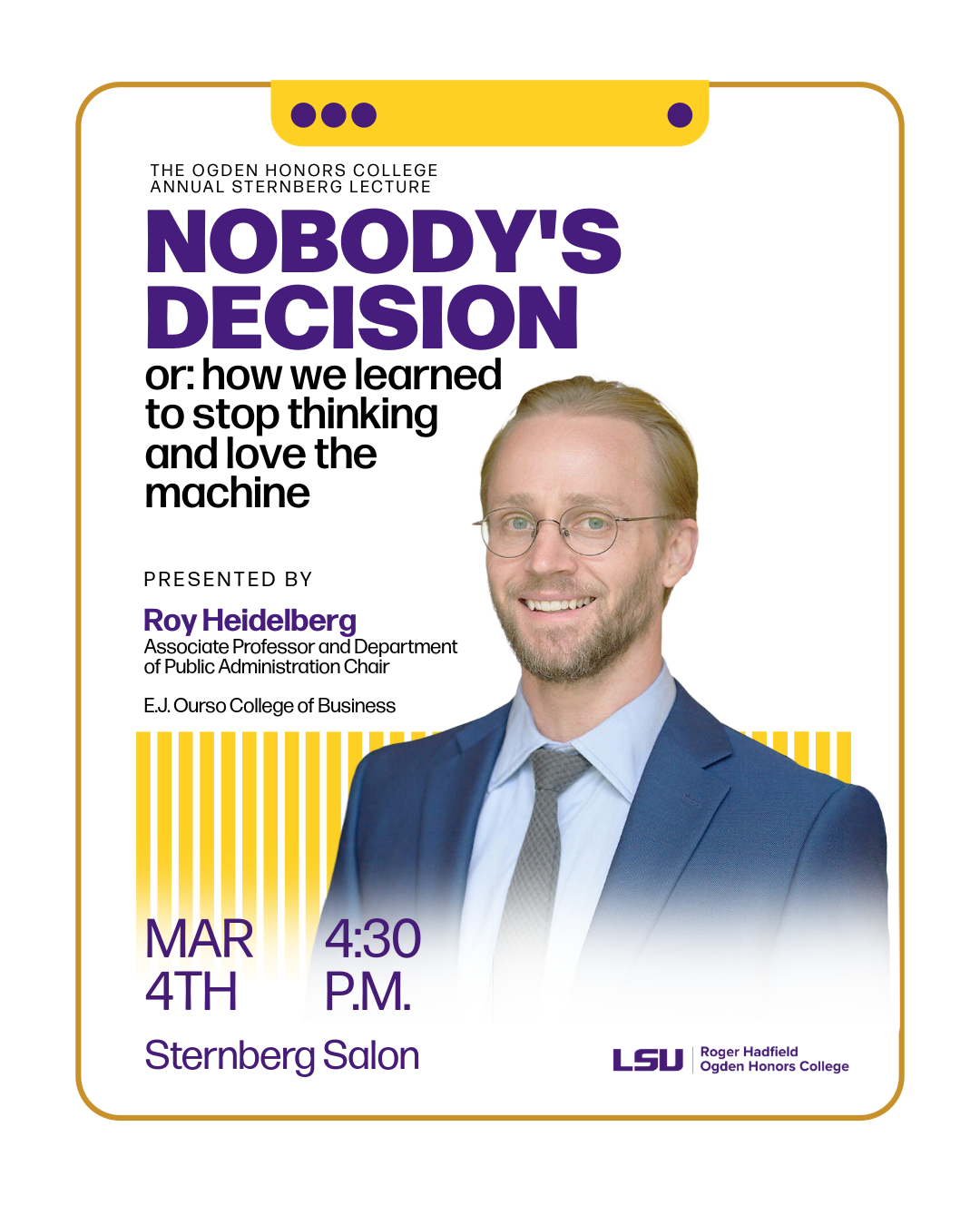
Last year, Heidelberg released a book titled Nobody's Decision: AI and the Perfection of Bureaucracy. This lecture continued the conversation, unpacking artificial intelligence's impact on governance and legitimacy.
Rather than treating AI as a sudden technological rupture or marvel, Heidelberg situated it within centuries of systems designed to make thinking permanent, structured, and administrable. Drawing on ancient philosophy and contemporary debates about large language models, he examined what actually changes (and what doesn't) when decision-making becomes increasingly automated.
His core question reframed the entire conversation: it's not whether machines can think like us, but what happens when our institutions are built to think like machines. This distinction matters profoundly for educators, policymakers, and anyone concerned with how organizations make decisions.
The lecture employed examples from education and public life to illustrate how bureaucratic
systems have always been engines for removing individual decision-making from decisions.
From the earliest written records and administrative codes to modern government processes,
institutions design procedures to reduce the role of human judgment, preparing the
ground for machines to do the same.
How Honors Students Are Learning About Automation
The Ogden Honors College has demonstrated growing engagement with artificial intelligence as both a subject of critical inquiry and a practical tool. Last year, Honors students participated in a seminar, "HNRS 2035: Design and Deployment of Large Language Models in Business," which examined LLMs from strategic and ethical perspectives. Additionally, several Honors students showcased their work in the College of Engineering's AI Showcase last fall as part of a capstone project.
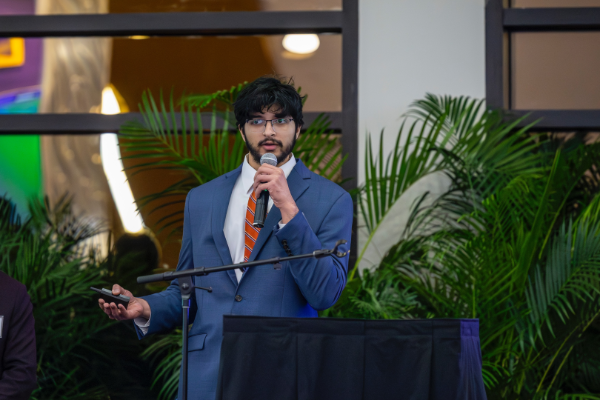
An Honors engineering undergrad presenting at the College of Engineering's AI Showcase at the end of the fall 2025 semester.
Heidelberg's Sternberg lecture deepened this conversation, inviting Honors students
and faculty to think critically about what we're actually doing when we automate decision-making.
His historical perspective, stretching from ancient bureaucratic thought to contemporary
machine learning, offered Honors students the intellectual tools to move beyond hype
and ask more searching questions about AI's role in governance, education, and institutions.
Why It Matters
Roy Heidelberg's work reminds us that artificial intelligence did not emerge from nowhere. It is the latest chapter in a much longer story about writing, administration, and the perpetual human drive to systematize thought.
For Honors students navigating a rapidly changing world, this lecture offered a framework for understanding not just whether AI will transform our institutions, but how to think critically about that transformation and ask the right questions about governance, power, and human agency.