
Pennington Biomedical’s Study of Assumption Parish Shares Initial, Surprising Data
March 16, 2026
- Researchers at LSU’s Pennington Biomedical Research Center are collaborating on a large, first-of-its-kind study funded by the National Heart, Lung, and Blood Institute, part of the National Institutes of Health, to find out why people who live in rural areas suffer disproportionally from heart and lung diseases, high blood pressure and stroke, high blood sugar and diabetes, and obesity.
- LSU’s team has been working with two rural Louisiana parishes, Assumption and Franklin, which—despite similar demographics—see radically different health outcomes: some of the best (Assumption) and some of the most challenging (Franklin) among rural communities across the South.
- After collecting data from one in every two dozen adults in Assumption Parish, the researchers are sharing initial findings with parish residents this month. Franklin Parish data will be released next.
- While the Louisiana parishes have yet to be compared with each other and with rural counties in America, one of the key takeaways so far is this: Your health is strongly tied to your education level—and much more so than to your income or age.
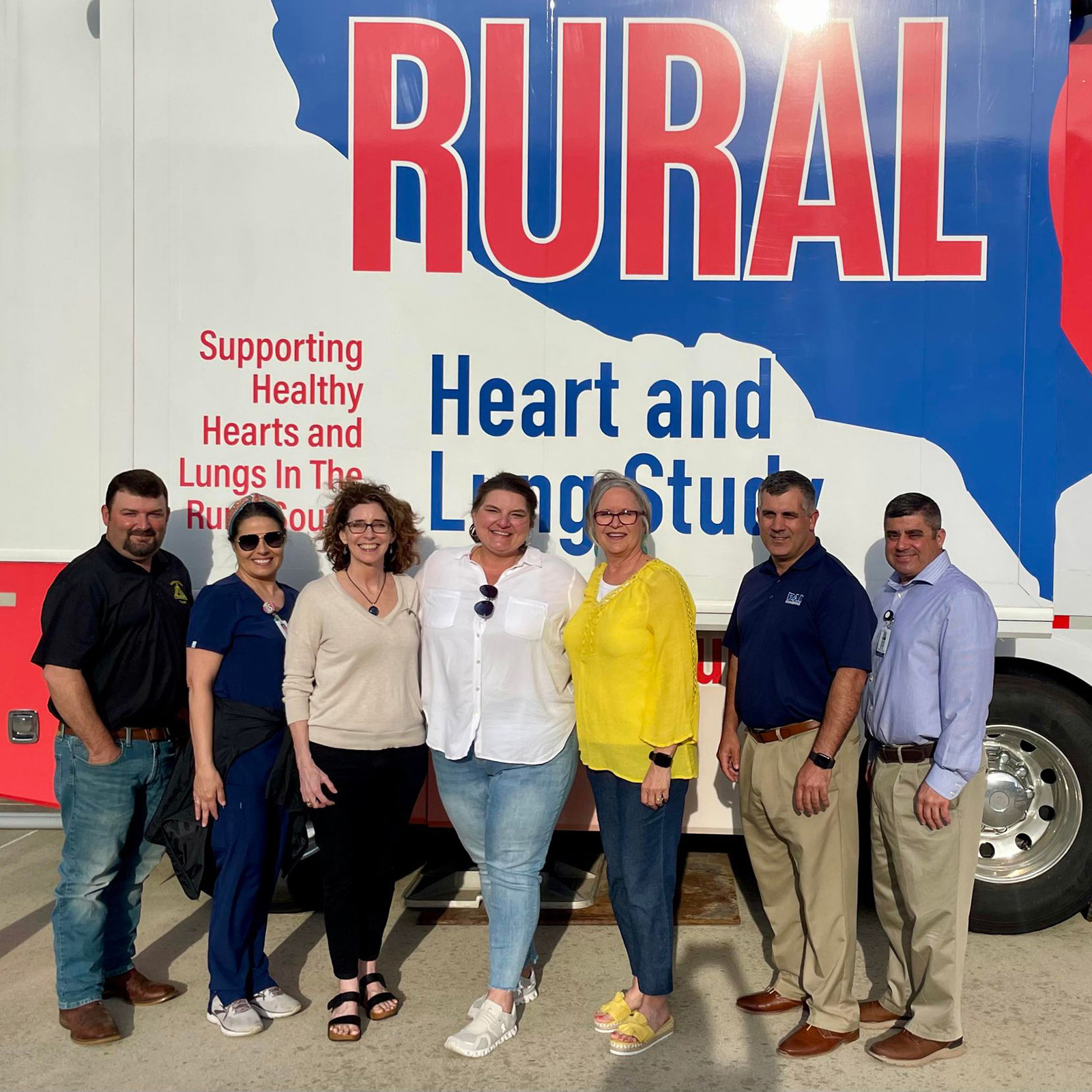
Kicking off RURAL in Assumption Parish. From left to right: Assumption Parish Police Juror Michael Dias; Our Lady of the Lake Assumption Ancillary Support Coordinator Stephanie Domingue, RURAL Louisiana Lead Investigator Stephanie Broyles, Community Engagement Coordinator Erin Theriot, RURAL Community Advisory Board Chair (Assumption Parish) Robin Landry, Assumption Parish Police Jury President Leroy Blanchard, Our Lady of the Lake Assumption Hospital Administrator Brian Tripode..
“That one surprised me,” said Stephanie Broyles, lead researcher on the study and director of the Contextual Risks Factors Laboratory at LSU’s Pennington Biomedical Research Center. “Education level brought out stark contrasts we didn’t necessarily see when we looked at something like income, for example. But why? That we don’t know, at least not yet.”
What the study found is that residents who didn’t graduate from high school are more than twice as likely to have high blood pressure and high cholesterol than those who went to college.
“These initial data open up a lot more questions, but we see them as conversation starters, not conversation enders,” Broyles said. “Why is it we’re seeing more disease in people with lower education levels? Is it because they’re working in jobs that don’t carry health insurance? Is it because they know less about behaviors that could improve their health? We’re not sure, and it’s premature to assume why we’re seeing these patterns. Just because there is a strong correlation between two data points doesn’t mean one is the cause of the other.”
The RURAL Heart & Lung study (RURAL is an acronym for Risk Underlying Rural Areas Longitudinal) is happening in 10 rural counties and parishes in Alabama, Kentucky, Louisiana, and Mississippi. It involves teams of scientists from 16 different institutions, including LSU. A special vehicle, or mobile examination unit, traveled to both Franklin Parish and Assumption Parish in 2024 to collect data. Study participants—hundreds of parish residents—each spent about three hours in the unit, answering questions and getting a variety of tests, including urine and blood collection to measure blood sugar and cholesterol, an echocardiogram, a CAT scan, and a pulmonary function test. Every four years, the same people will be tested again to see how their health evolves over time.
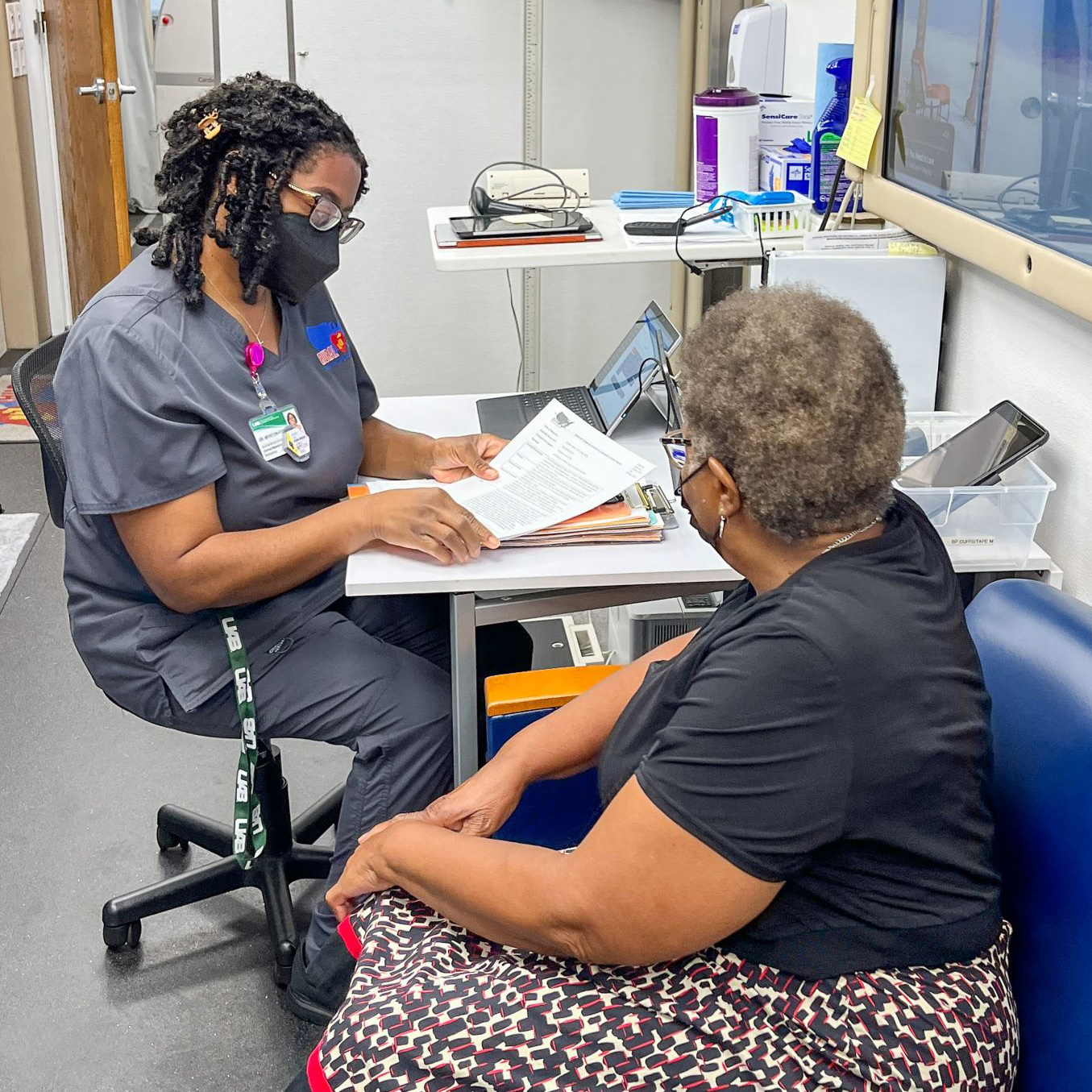
Shelicia Morton-Ford, clinical research nurse coordinator for the RURAL study, goes over informed consent with a RURAL participant.
Erin Theriot, a lifelong Assumption Parish resident who was hired by LSU as a community engagement coordinator for the parish, was surprised by how many residents wanted to participate.
“When they told me we had to recruit 400 people, I thought, ‘Oh, God’—Assumption is pretty small,” Theriot said. “But we partnered with the community, gained support from the community hospital and the police jury. Facebook was phenomenal for us as well. We aimed for 400 people and got 460—that’s one out of every 23 adults in the parish!”
Theriot’s next challenge is to get the initial study results into the hands of as many residents as possible.
“We’re going to be at community events, getting into doctors’ office waiting rooms, you name it,” Theriot said. “Also, our Community Advisory Board has been a great resource for us.”
People in the rural South have some of the shortest life expectancies in the country, and the RURAL study is the first of its kind to focus solely on rural residents’ health.
“Scientists aren’t sure why these areas are at greater risk, and more research is needed to find out. Historically, rural residents have not been well-represented in health research, and that’s what we’re working to address.”
Stephanie Broyles, RURAL Heart & Lung Study lead in Louisiana and researcher at LSU’s Pennington Biomedical Research Center
In Assumption Parish, 80% of adults suffer from overweight or obesity. That is higher than in Louisiana overall (72%) and in the U.S. (68%). Obesity rates differ the most by education level: 75% of those who didn’t complete high school have obesity compared to 48% of those who attended at least some college. High cholesterol and high blood pressure are more than twice as common in the less educated group.
One of the biggest surprises to the researchers themselves is how many cases of undiagnosed and uncontrolled high cholesterol, high blood pressure, and high blood sugar they found.
“This was something that really jumped out a lot to me, and a place where I think we, as LSU and Pennington Biomedical, could potentially intervene and make a difference,” Broyles said.
Among those who didn’t think they had high cholesterol, high blood pressure, or high blood sugar, as many as one in three, half, and one in four, respectively, had higher than normal levels. Among those who already knew they had high cholesterol, high blood pressure, or high blood sugar, as many as one in four, three in four, and nine out of 10 still had higher than desirable levels.
“As a physician practicing family medicine for 48 years and being a lifelong resident here, I have felt many residents are undiagnosed, and the RURAL Heart & Lung study has now revealed that to be true.”
Dr. Charles Bolotte, Assumption Parish physician
Some study participants had never had their levels checked before, or at least not in a long time.
“I am convinced this study saved my life—I feel so fortunate to have been a part of it,” a study participant and Assumption Parish resident said (participant identities must remain confidential as per the study lead’s compliance requirements). “The screenings we did in the mobile examination unit gave me a baseline I’d never been able to have before. I am now being treated for a condition I didn’t even know I had before RURAL.”
The results will be shared with the public both digitally and in print.
“Our focus right now is to connect our initial report on Assumption Parish with the people who can use it to really make a difference,” Broyles said.
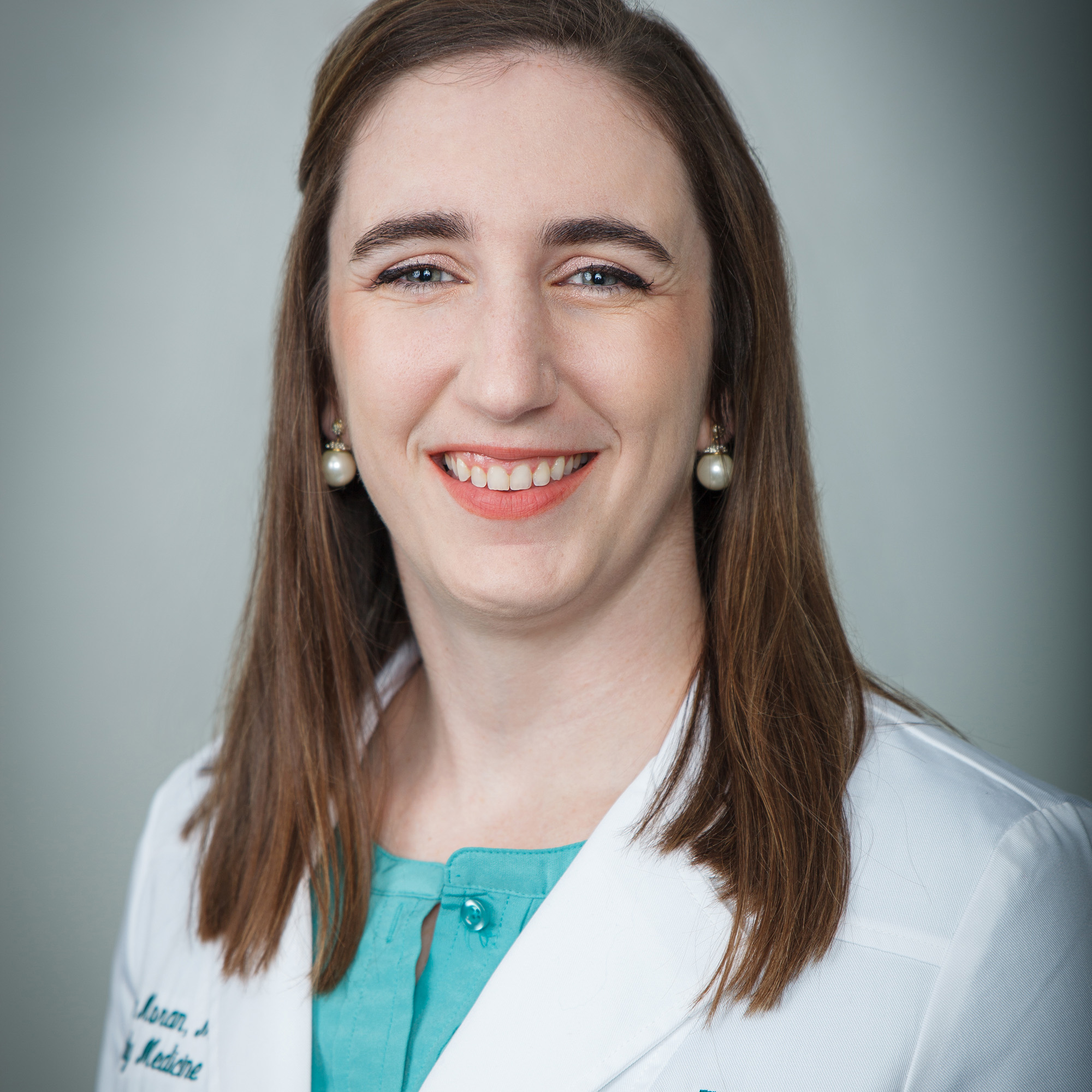
Dr. Aimee Moran at the Thibodaux Regional Family Medicine Clinic is an LSU and LSU Health New Orleans graduate who encouraged her patients to participate in the study and also chose to participate herself.
One of those people is Dr. Aimee Moran at the Thibodaux Regional Family Medicine Clinic. She grew up in Napoleonville in Assumption Parish, graduated from LSU with a bachelor’s degree in biochemistry as a University Medalist with Honors in 2014, completed her medical school training at LSU Health New Orleans in 2018, did her residency at East Jefferson General Hospital, and then returned home to join Dr. Landry (her dad) and Dr. Gravois at the Thibodaux clinic in 2021. As a community physician, she encouraged patients to sign up for the RURAL Heart & Lung Study and signed herself up, too.
“I wanted to know what patients would be going through and could then speak to them about how easy it was to participate,” Dr. Moran said. “Meanwhile, the study forced some patients to confront their health head on.”
“Assumption Parish residents are a proud lot, and it is especially hard to ask for help when problem areas are not identified. With the study providing data, we can discover trends, and design and implement meaningful programs that directly impact the health of our residents, while creating jobs.”
Dr. Aimee Moran
Assumption Parish is often lumped in with neighboring parishes, such as Ascension and St. James to the northeast, or Lafourche and Terrebonne toward the Gulf. One of the main hypotheses of the RURAL Heart & Lung Study, however, is that rural areas can be quite different from each other in terms of health. Dr. Moran appreciated the RURAL Heart & Lung Study working with Assumption Parish and its residents directly.
“Other communities have environmental factors and economic resources that are very different from what is here in Assumption Parish,” she said. “By coming directly to us, we now have concrete information we can use to directly affect outcomes.”
Read the Assumption Parish Data Book