
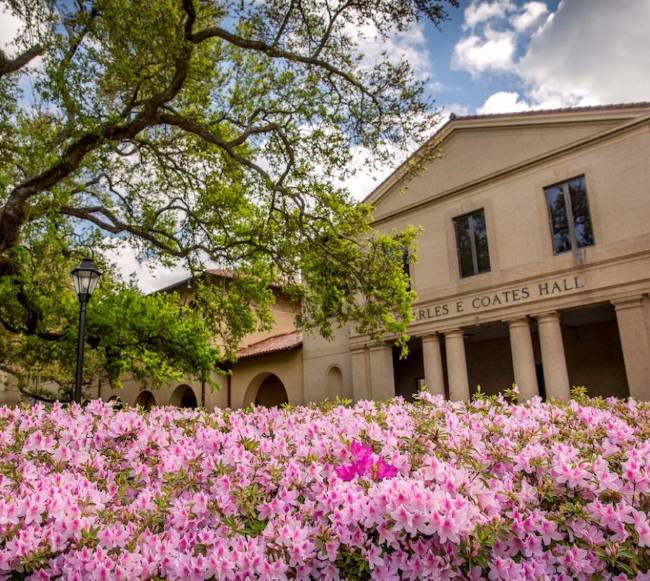


Meet Max Conrad: 60 Years at LSU, 60 Years of Artful Collaboration with NASA
December 16, 2025
LSU’s second-longest-serving professor, Max Z. Conrad, is about to retire from teaching. His long career traces the outlines, primarily in pencil, of an ambitious America since the 1940s and World War II as science shaped a victorious nation toward the beautiful and the bold—and the better, mostly.
“You always need a sharp pencil and a good eraser,” Conrad said.
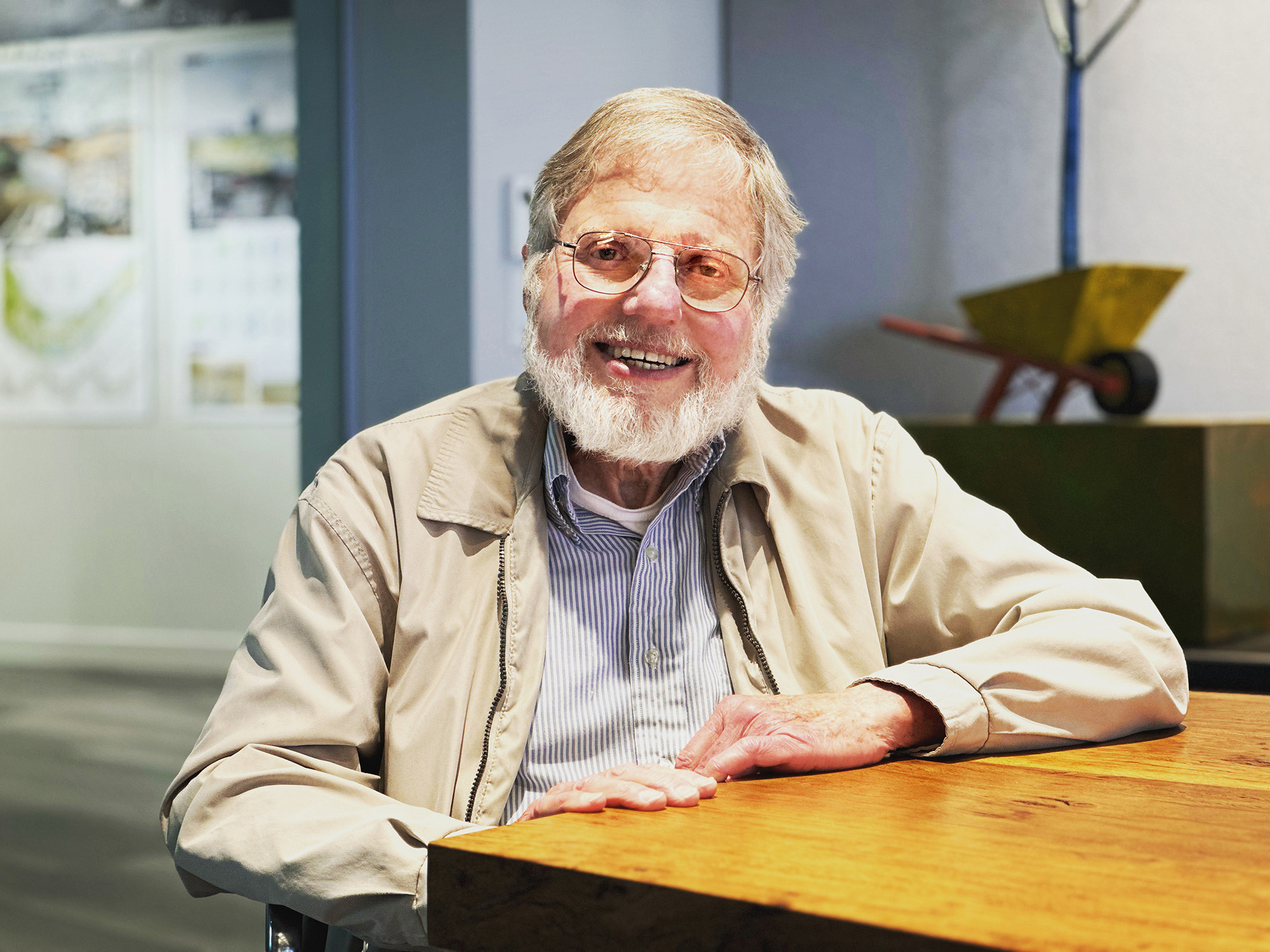
Max Conrad, an LSU and Harvard graduate, did not intend to teach at LSU for 60 years. “But luck is the story of my life,” he said. “Things just happen.” (Photo by Elsa Hahne.)
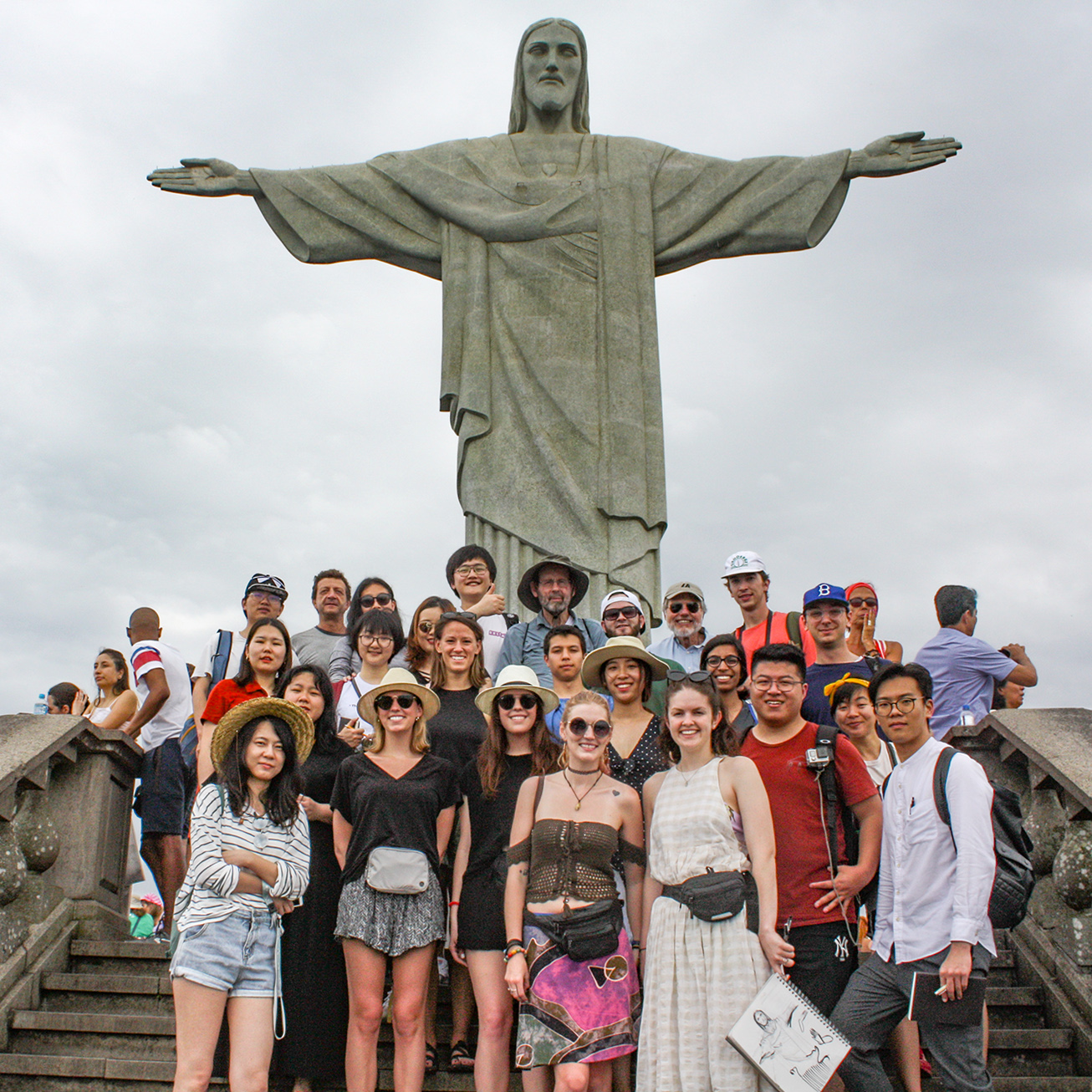
Max Conrad (back row in a beige baseball cap) with a group of LSU landscape architecture students during one of his many international field trips, this one to Rio de Janeiro, Brazil.
Recruited by Robert “Doc” Reich to help build LSU’s nation-leading landscape architecture program in 1966, one of Conrad’s signature efforts has been taking students on international field trips to explore the wonders and woeful errors of urban and regional planning all around the world. The stately Taj Mahal in India; the quiet Lingering Garden in Suzhou, China; and the bustling Copacabana in Rio de Janeiro, Brazil.
Landscape architecture is not the same as landscaping, Conrad is always quick to explain. Instead, it’s the purposeful design of land, water, and plants to nudge nature into useful balance with the wants and needs of people as they live, work, and move around.
“As soon as you get outside the skin of a building, you have landscape architecture,” Conrad said. “Some people think landscape architecture is only decorative, but that’s like referring to interior design as ‘pillow-fluffing.’ Interior designers are not decorators, just like we’re not landscapers.”
“We deal with living materials and plants, and plants are very important. Not only for decorative purposes, but to shape spaces and make them useful as well as beautiful.”
Max Conrad
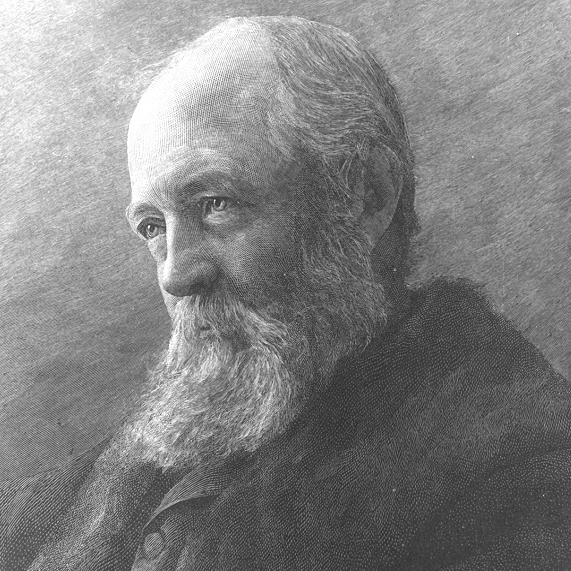
Frederick Law Olmsted, the father of American landscape architecture. His sons, the Olmsted brothers, designed LSU's flagship campus in Baton Rouge as well as Stanford University in California, which explains why the two campuses look so much alike.
In America, landscape architecture emerged as a discipline with the creation of public gardens and parks, the most notable being New York’s Central Park in 1858. Designed by Frederick Law Olmsted, the father of American landscape architecture and co-founder of the American Society of Landscape Architects (which awarded Conrad the Jot D. Carpenter Teaching Medal in 2013), Central Park was created to bring health and fresh air to all residents of the growing metropolis and help ease socioeconomic tensions tied to the tenements and wealth disparities. In 1921, it was Olmsted’s sons who designed LSU’s flagship campus in Baton Rouge. They also designed Stanford, which is the primary reason the two campuses look, well, like brothers. Much later, landscape architecture would contribute to the development of Geographic Information Systems, or GIS, combining its original focus on human and environmental health with deeper, data-driven analysis of the hydrology, topography, and vegetation of places.
Conrad’s story began in New Orleans, Louisiana, and stretched west to California before he returned home to pursue his bachelor’s degree in landscape architecture at LSU between 1957 and 1961. After that, he was off to Harvard Graduate School of Design, receiving his Master of Landscape Architecture in 1963. In Boston, he also learned computer programming—a brand-new discipline at the time—at neighboring MIT. Next, he joined NASA at the height of the Space Race, working in Huntsville, Alabama, home to Army Missile Command and Marshall Space Flight Center.
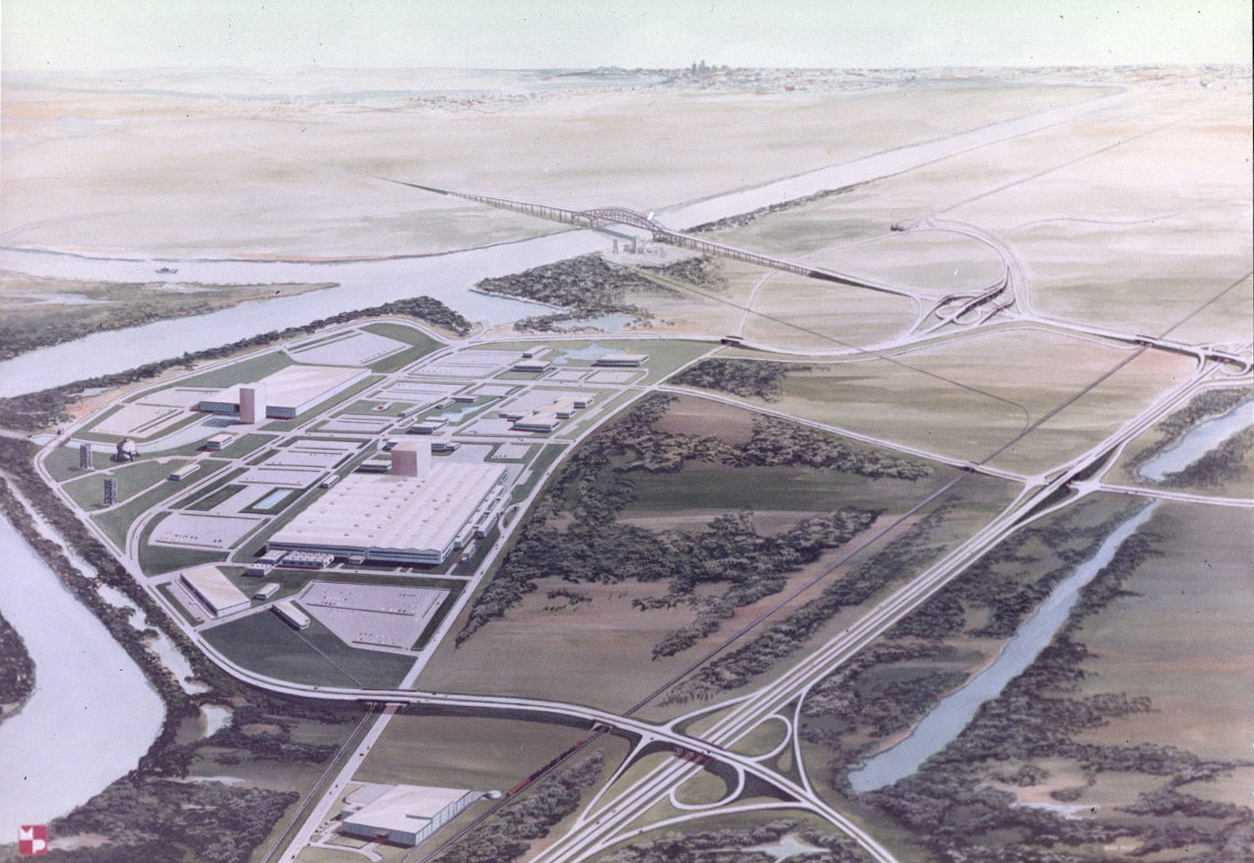
An artistic drawing of NASA’s Michoud Assembly Facility in New Orleans as Max Conrad helped design it. The "MP" badge in the lower left corner stands for Master Planning, the office where Conrad worked. He recalls, “I made the Michoud master plan showing circulation, parking, drainage. You can see on the master plan the canal leading to the locks that would lower and raise the water inside the building to move the rockets in and out. A master plan, like we made, precedes the making of construction drawings that are based on the layout of the master plan. Our office did this for all NASA facilities all over the U.S.”
As soon as he arrived at NASA, Conrad drew the original master plan for the NASA Michoud Assembly Facility in New Orleans, also known as “America’s rocket factory.” The Saturn rockets for the Gemini and Apollo programs in the 1960s and ’70s were built there, and the Space Launch System is being constructed there today for the ongoing Artemis program. Much of this work relies on LSU equipment and support through its National Center for Advanced Manufacturing, or NCAM. Meanwhile, Conrad’s collegues in the LSU College of Art & Design and the Digital Media Arts & Engineering program are collaborating with NASA on the development of the first real-time virtual representation, or digital twin, of the two-million-square-foot Michoud facility to optimize the mission-critical work that takes place within its physical walls through computational modeling.
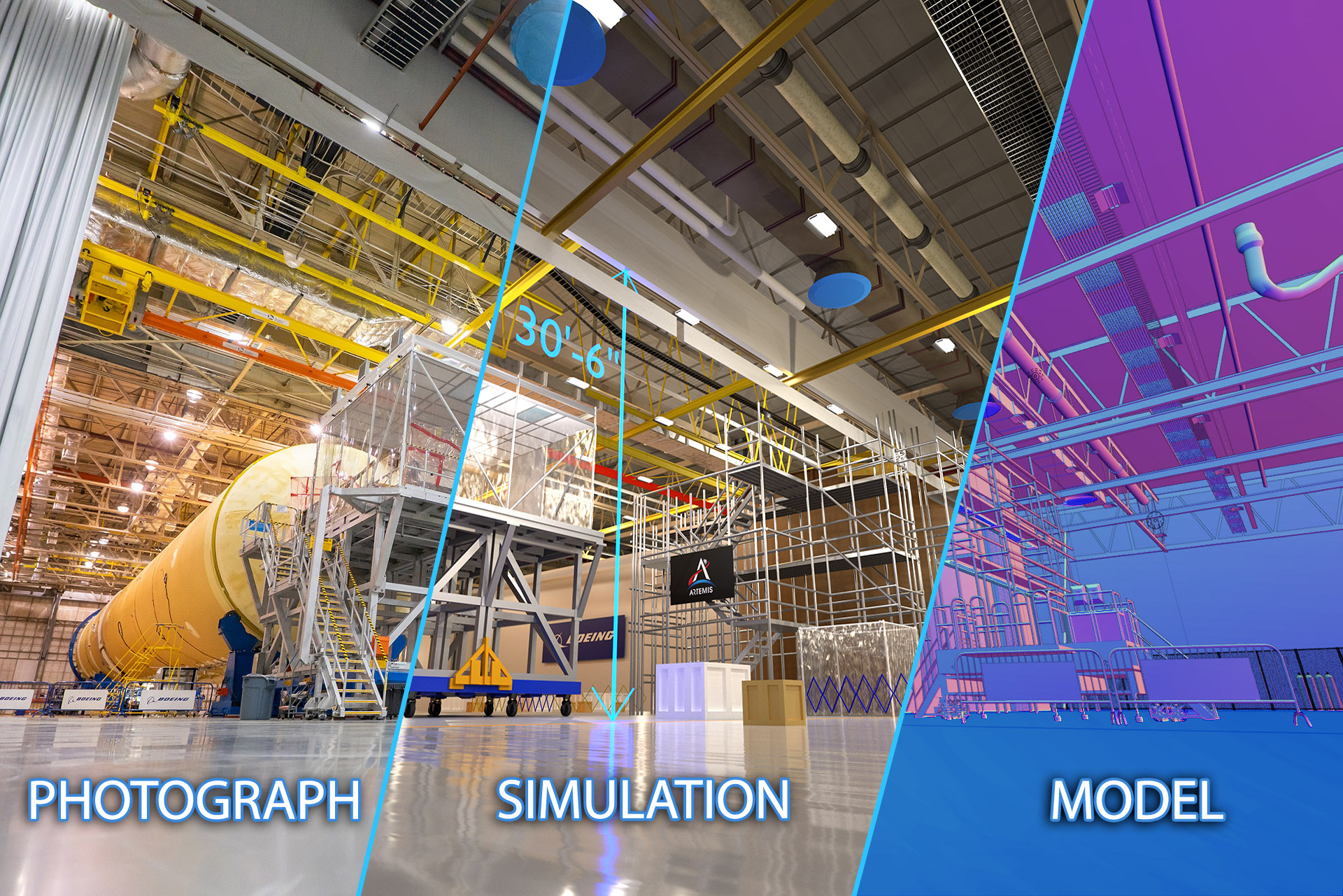
LSU's NCAM and digital twin team led by Derick Ostrenko and Jason Jamerson, both faculty in the LSU College of Art & Design with joint positions in the LSU Center for Computation & Technology, were awarded $7.5 million by NASA to develop a digital twin of the Michoud Assembly Facility in New Orleans to support NASA operations almost 60 years after Max Conrad drew the original master plan for the facility in pencil.
Now, let’s retrace Conrad’s story in his own words.
Not everything comes up roses
“From the time I was a little kid, I was fascinated by flowers. While we lived surrounded by cemeteries near New Orleans City Park, a friend of the family was living out on Metairie Ridge and had a little farm. He was a cabinet maker like my grandfather. They worked for New Orleans Public Service, or NOPSI, to fix the seats for the streetcars and that kind of stuff. But his family background was in farming, so he knew how to grow things. He could graft and prune and do what’s called budding, where you grow one plant on another plant. He was an accomplished amateur horticulturist, and he would take me to his house where he grew roses.”
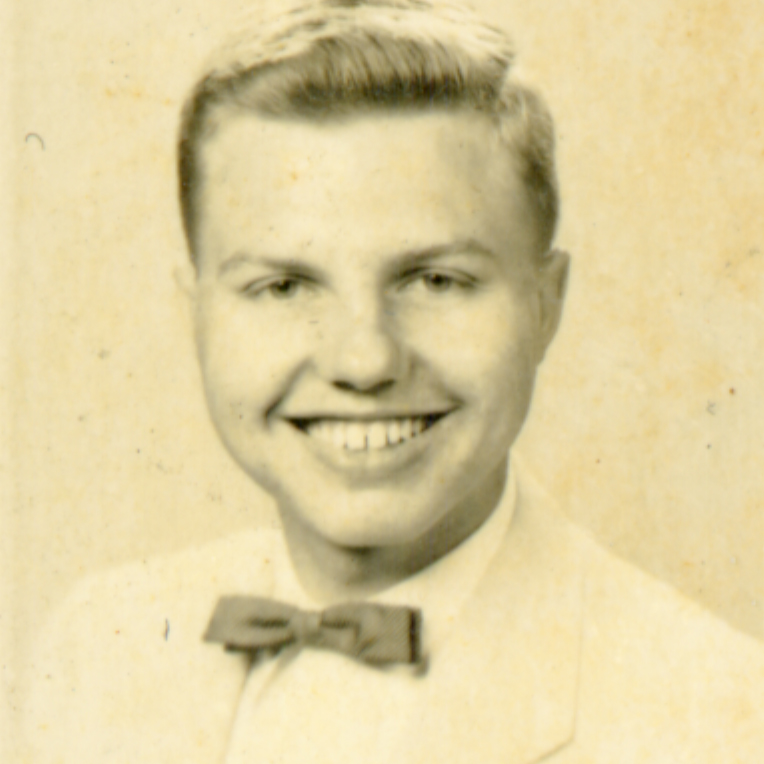
Max Conrad at his 8th grade graduation.
“I became fascinated with roses. I started growing them and breeding them—saved what little money I had to buy more. I got very good at it. Meanwhile, he was a member of the New Orleans Rose Society, so he’d take me with him. He was a very nice person. I was just a little kid, and it was generally all older people who’d do things like belong to rose societies. They even made me an honorary vice president! Eventually, in fifth grade, I won a prize for a rose that I grew.”
“That blue ribbon was my deepest, darkest secret because boys didn’t grow roses, right? I always did stuff that wasn’t boy stuff. Just wasn’t interested, and never played sports. To this day, I don’t know anything about it.”
“Well, they published the winners in the paper. My teacher saw the article and spilled the beans and outed me… ‘I want to tell the class that Max is in the paper... He won a price for a rose that he grew...’ I’d been exposed. From then on, I was called Rosebud.”
Z, but not for Zorro
“My father worked at the Times-Picayune, the local newspaper in New Orleans, because his uncle Charlie was one of the bigger wheels there. My daddy’s name is Charlie, too. This was during the Depression, and my father was in the photo engraving department. Putting a picture in the paper was complicated at the time. You had to take a picture, and it had to be converted into little dots, like pixels, and transferred. One of the artists there—they had real artists who would make beautiful sketches and diagrams—was named Capone. He was Italian. His first name was Zeph, short for Zephirin. ‘That’s my lucky name!’ Zeph would always say, and I was named after him.”
“I’ve been lucky all my life. I’ve been run over by a couple of people. Had my leg broken and my head bashed in. But I survived. You’re lucky if you survive.”
Max Conrad
It came in the mail one day
“When I was a kid, I always loved to get mail. It was a big thrill. You could get a postcard for a penny and believe it or not, the post office would deliver it. You could send off for stuff that would come in the mail for free, and I’d send off to get anything.”
“One day, a magazine showed up. Never had one prior. It was a magazine from the Chrysler automobile company. On the back cover, there was an upside-down picture, and the title was ‘The School That Is Upside Down.’ It was Cal Poly, near Los Angeles, in a place called San Dimas, which is backed by Pomona and now a big campus. At the time, it was a tiny little school.”
“At the bottom of the page, they described how the students all learned by doing—build stuff and grow flowers. Ah, flowers… I’d watched, on early television, the Rose Parade. The students would design the floats and grow the flowers and put them on the floats. That’s all it took. I got a postcard and wrote off: ‘I’m interested in your school. Could I come study horticulture and learn about growing flowers?’”
It is 1956. President Dwight D. Eisenhower is reelected and signs the Federal Aid Highway Act of 1956, creating the U.S. Interstate Highway System. The hard disk drive is invented by an IBM team. An American Lockheed U-2 reconnaissance aircraft makes its first flight over the Soviet Union. In Louisiana, the Lake Pontchartrain Causeway opens, while LSU and Southern University both establish campuses in New Orleans.
Hunger and love for Monday mornings
“Cal Poly had two campuses at the time. One in San Luis Obispo, where they didn’t have space for me in the dormitories, and one in San Dimas, where there was space. It was an inexpensive school, and the California students paid zero tuition. To get there, I learned I could get a Greyhound bus ticket to go anywhere in the U.S. for $99. So, I didn’t take the direct route to California from Louisiana. I bought a ticket that went the longest possible route.”
“Once I made it to Las Vegas, I got worried. I had this dream of California as the land of flowers and roses, but I’d only seen California in movies, which were fake. Remember—there was no internet at the time. Had I been wrong?! I looked at the map and saw Las Vegas was very close to San Dimas. ‘This looks bad...’”
“Once I got to the campus, the dormitories weren’t open, but the guy who came to pick me up at the bus station knew of one that was, and it belonged to the football team. I thought, ‘Now I’m in serious trouble…’ I knew nothing about sports, and the idea of hazing was terrifying to me. ‘What are these guys going to do to me?’”
“I was starving when these giants entered the room. But they were the nicest guys you’d ever meet, and they knew where the cafeteria was and took me to dinner.”
“Now, being a Louisiana guy, I’d never had plain cooking, and this was plainer than plain. The stuff looked unrecognizable to me but being hungry helped. I’d eat anything, even cottage cheese! I’d never seen that before. At home, we had Creole cream cheese.”
Max Conrad
“But this was a commuter college. Only a few people were left on the campus on the weekend, while everybody else went home, so the cafeteria closed. The people who had money and a car, they’d go off and buy food. I didn’t, I’d arrived with a bicycle. So, what did I do? The campus was in the middle of orange groves and avocado orchards. You can eat only so many oranges in a weekend, and the avocados weren’t ripe yet. It got to where I couldn’t face another orange. It would make me ill. But I discovered that if you lie in bed and don’t move, you don’t get too hungry. So, every weekend I starved, and learned to love Monday mornings.”
It is 1957 and the Space Race begins with the launch of the Soviet satellite Sputnik 1, the first artificial satellite to orbit the Earth, and then Sputnik 2 with the dog Laika on board and no technology available to return her to Earth. IBM sells the first compiler for the brand-new FORTRAN (FORmula TRANslation) programming language. In Louisiana, Hurricane Audrey demolishes Cameron Parish, killing 400 people.
Becoming a Tiger
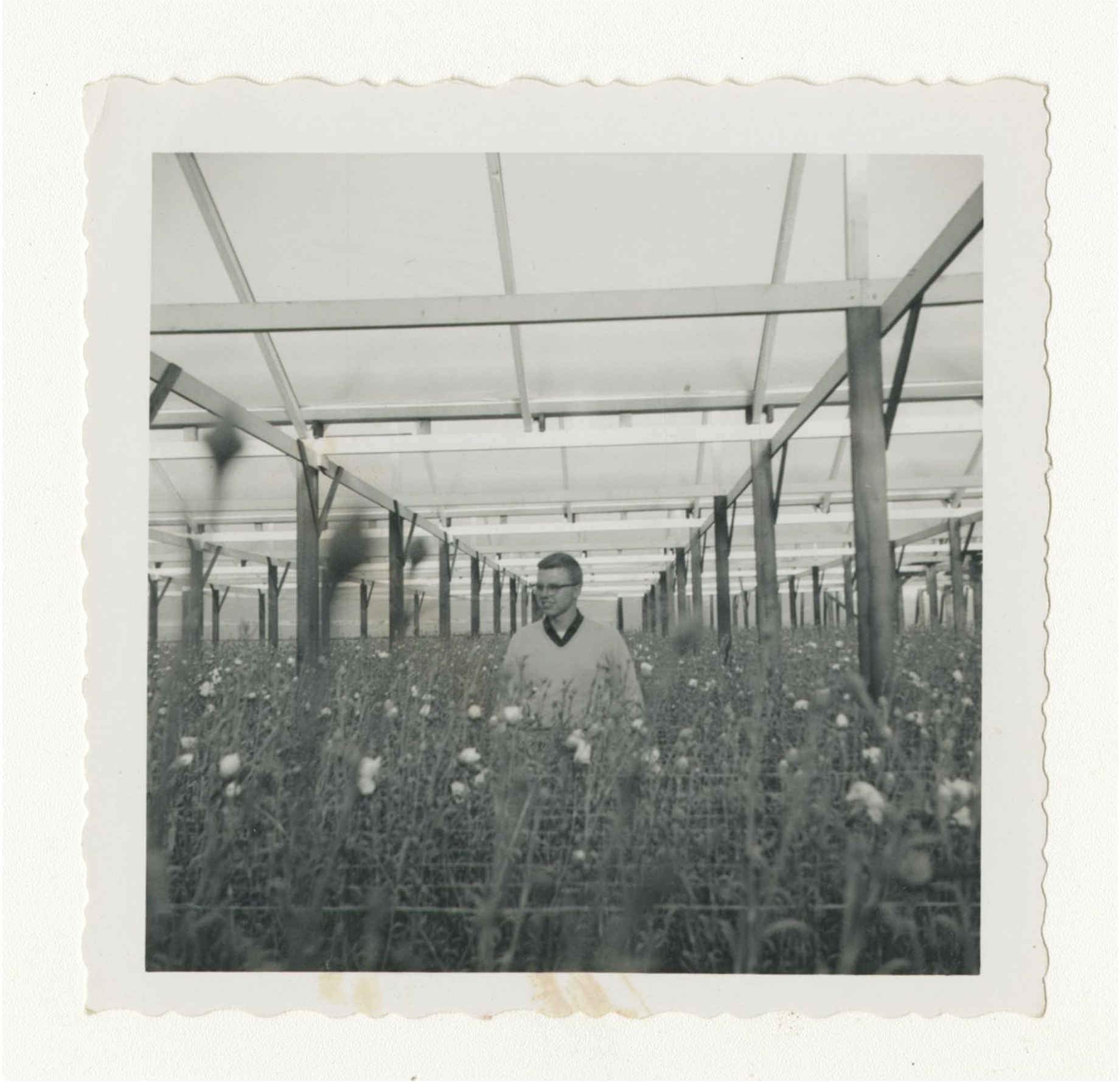
Max Conrad is the happiest around flowers.
“Somehow, I made it to the end of the year at Cal Poly, but during Christmas break, when I was able to come home, I thought, ‘Maybe I can’t starve another semester. Maybe I’ll go see about LSU.’”
“I looked at the course catalogue, but LSU offered only general horticulture, not ornamental horticulture. It covered strawberries and sweet potatoes and all kinds of crops, not just flowers. LSU being an agricultural and mechanical college, you also had to take a course in animal husbandry and organic chemistry. That didn’t sound good to me. But I kept coming across something in the catalogue named landscape design—it wasn’t called landscape architecture yet.”
“I was told to go see this guy; I thought his name was Dr. Riche, not Reich. It was a one-room schoolhouse, but when Doc saw an opportunity to recruit somebody for his tiny little schoolhouse, he recruited you. He just signed me up!”
Max Conrad
“Reich brought me to the studio and showed me the drawings on the wall that looked very much like my idea of California. I thought to myself, ‘This is it—I’m in the right spot! This is just like Cal Poly, but with food.’”
“But I didn’t notice one little detail. I had to take two years of architecture first… Reich couldn’t teach everything, so he let the architects teach. Well, all I could see in my brain was the plants, and that overshadowed everything. I said, ‘Okay, I’ll learn how to draw a house…’ That was my idea of architecture at the time.”
“It was a big class. Must have been 120 people. The other students already knew mechanical drafting, while I knew zero. My first project, I didn’t know graphite will smear. Well, it smeared. I made a black drawing. I was an A student prior to this, but I didn’t get an A, B, C, D, or an F. I got a zero, and it said, ‘KYPS NCC.’ What the heck did that mean!? ‘Keep your pencils sharp—not college caliber.’ But somehow, I persevered and learned to like it.”
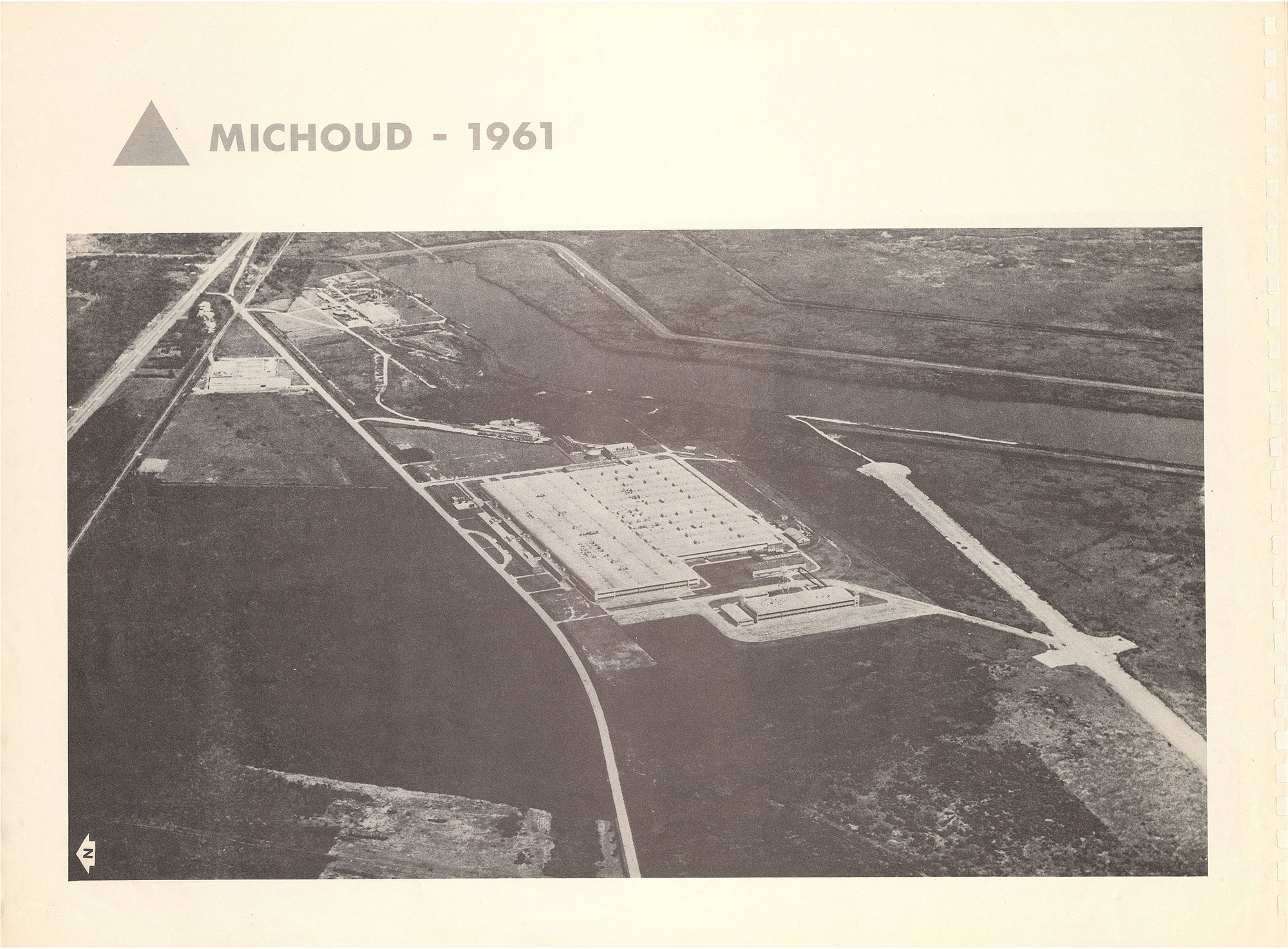
Michoud in 1961.
It is 1961. John F. Kennedy is sworn in as president and sets the national goal of “landing a man on the Moon and returning him safely to the Earth” before the end of the decade, launching the Apollo program under then-nascent NASA; Soviet cosmonaut Yuri Gagarin shocks America by becoming the first human in space, orbiting the Earth once before parachuting to the ground, while Alan Shepard becomes the first American in space not even a month later. In New Orleans, the desegregation of public schools continues with Ruby Bridges spending her first year at William Frantz Elementary in the Upper Ninth Ward.
Going to Harvard
“How did I go to Harvard? That was luck. I was a guy who had no money to go. But Doc—or the Wizard of LSU, as I call him, because he would cast his spell and then you did whatever Doc wanted you to do—he wanted me to go to Harvard.”
“I had no desire to go to Harvard. After graduating from LSU, I wanted to travel, and this LSU architecture teacher I liked very much, Bertram Berenson, found out. He tried to help me. He said, ‘You should go to officer candidate school in the Navy because officers get to travel, and when the boat arrives, you can get off and see things.’ That’s all he had to say. I applied and through some miracle I was able to pass the test. The math problem dealt with navigation, which I’d never done, but through some luck, I got it right using the Pythagorean theorem. It came to my rescue, and I was assigned to officer candidate school.”
“Well, the Wizard of LSU discovered this, and he was a pacifist. ‘No!’ he said. ‘You’re not joining the Navy—you’re going to Harvard Graduate School of Design.’ ‘No, Doc,’ I said. ‘I already signed the contract.’”
“Next thing, I get a letter from the Commandant of the Navy. It read, ‘Dr. Reich spoke to us, and we would prefer to have you after you graduate from graduate school. Goodbye.’ So, Doc got me out of a contract with the federal government. Wizard, right?”
“Then, ‘Doc, I can’t go to Harvard—I don’t have the money…’”
“LSU at the time, the tuition was $35 per semester, and my father would go knock on one of the state legislator’s doors and beg for what was called a legislative fee exemption scholarship so we wouldn’t have to pay the $35.”
Max Conrad
“In my family, $35 was a lot of money. My dad made a low salary, $4,000 a year, and I didn’t realize we were as poor as we were because it was just normal. Harvard, meanwhile, was $3,000.”
“‘Write to Mr. Sasaki,’ Doc said. He was the head of the Harvard Graduate School of Design and the founder of the Sasaki firm, which was the biggest firm in the U.S. at the time. Doc said, ‘Write to Mr. Sasaki and tell him you need a scholarship.’ So out of respect for Doc, I had to write. Sasaki responded: ‘I’m sorry, Max, but we don’t buy students at Harvard...’ So, I went to Doc again. ‘Doc, they can’t give me a scholarship.’ Again, the Wizard goes to work... Next, I get another letter from Mr. Sasaki. ‘Max, we will give you a scholarship and you can work in my office to earn extra money.’ The spell was cast…”
“Next, I had to tell my father, who never graduated from 8th grade. ‘I’m going to Harvard, but I only have enough money to last me two months.’ He said, ‘Well, you run out of money, you’ve been to Harvard for two months.’”
Going to MIT
“While at Harvard, I lived in a shared attic room in an old Victorian house. The guy who lived there with me was always wrapped in a blanket, reading. ‘George, what story are you reading?’ ‘Oh, it’s not a story.’ It was page after page of mathematical formulas, and he’s going, ‘Ahhh… amazing…’ He was at MIT.”
“Later, I also became a student at MIT, for one class. They had these guys at Harvard who developed GIS, the geographic information system. It was in its infancy then; they were the first developers, and everybody wanted to know about it. I went up and sat with them and begged for information. One guy said, ‘I cannot speak to you unless you can program in FORTRAN and use the WATFOR compiler.’ At the time, at both Harvard and MIT, you could cross-register at either school. So, I said, ‘I’m going to MIT!’”
“The way they taught the class was interesting. The programming was too complicated to explain. You just had to do it to figure it out. She’d come in and give an assignment. ‘Do the Fibonacci numbers.’ I didn’t even know what those were, but everyone else did. I was the only non-MIT person in the class, but I managed to do some FORTRAN programming. I even built a program to calculate the interest on my bank account over so many years. I learned just enough to do elementary stuff in GIS, and later, when I came back to LSU, I did that here. Everything was on a punch card. You’d punch in your program and a card would come out and you’d bring that to the university computer—there was only one computer on this campus then, and it cost $6 million—and they would run your program for you and you would get the output back the next day and they would look at you and say, ‘Son, you have an error! You missed a comma.’ That meant starting all over again.”
It is 1963. President John F. Kennedy gives his “Ich bin ein Berliner” speech in West Berlin, Germany, and is assassinated in Dallas, Texas. The U.S. and the Soviet Union establish the so-called red telephone, a direct communications link between the Pentagon in Washington and the Kremlin in Moscow that was never red nor a phone, but actually a teleprinter or fax machine, now replaced by email. Martin Luther King Jr. delivers his “I Have a Dream” speech during the March on Washington for Jobs and Freedom, and NASA launches the world’s first synchronous satellite, which appears to always stay in the same position in the sky.
Joining NASA
Sarah Schnadelbach, granddaughter of Bert Schnadelbach, who worked in the NASA Master Planning Office with Max Conrad, graduated from the LSU School of Information Studies in August 2024. She earned a Master in Library and Information Sciences and a Graduate Certificate in Archival Studies and now works as a librarian in the Jefferson Parish Library System. Bert Schnadelbach was hired as lead landscape architect to transform Redstone Arsenal army base in Huntsville, Alabama, into the NASA design and testing center that would develop the rockets for America’s first manned space flights. Sara’s uncle Keith Schnadelbach followed in Bert’s footsteps and is also a landscape architect.
“When I was at Harvard, so was one of my classmates from LSU, named Terry Schnadelbach. He had graduated a year after me in architecture and we were both from New Orleans. For Christmas, we borrowed a friend’s car and drove home. After Christmas, Terry said, ‘We can stop in Huntsville and spend the night at my brother’s house. He works for NASA.’”
“When we got there, Terry’s brother said, ‘My boss wants to meet you.’ His name was Hannes Luehrsen and we saw all these pictures on the wall of rockets launchers. I thought, ‘My God, it’s real…’ and Luehrsen, who was German, said, ‘Ven you graduate, you vant to come vork for me?’”
“I didn’t know what I’d do there, but Terry’s brother Bert had also graduated in landscape architecture from LSU, several years before us, and he was working in something called the master planning office.”
“When it came time for me to graduate, Bert said, ‘Send your application in.’ Miracle of miracles, they offered me a job! People came from all over to interview me, although I didn’t know what for exactly. On the application, they asked, ‘How much do you want the salary to be?’ You realize—I was a starving student at the time. Never had money. Always hungry. So, I put $9,000.”
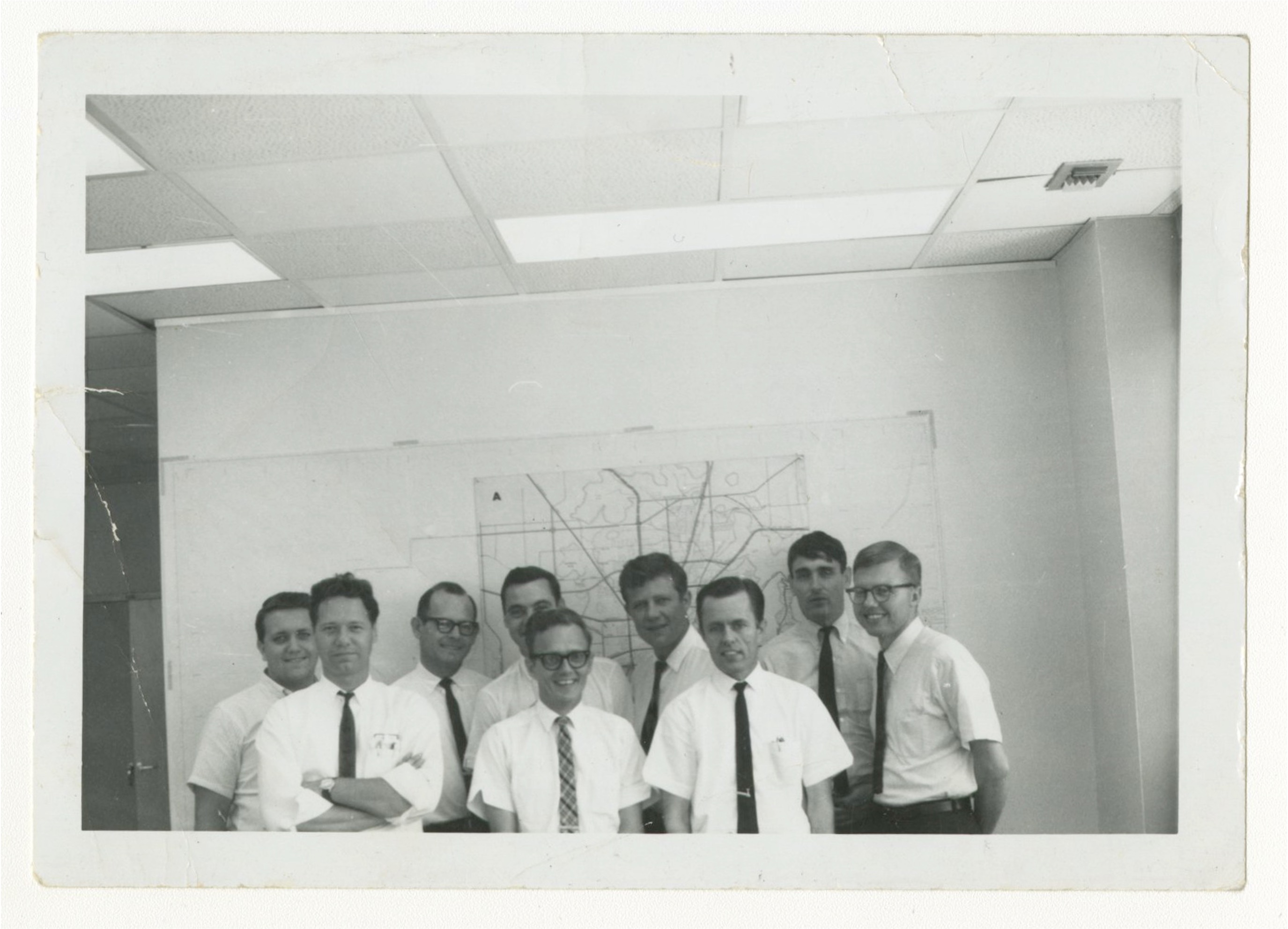
The design team in NASA's Master Planning Office with Conrad on the far right.
“I ended up in Huntsville in the heat of summer, and for the first time in my life, I could go to the Winn-Dixie store and buy whatever I wanted. That was my big day. Finally, I could have food.”
“What did I buy? Artichokes. I knew what they were because I’m from New Orleans, and they were giving the things away! No one was buying them. At the checkout, this little girl said, ‘What do you do with them things?’ I said, ‘Well, you throw most of it away,’ and she said, ‘I see—you throw them away.’ They didn’t know what artichokes were in Huntsville.”
“Huntsville at the time, we called it Hunt’s Patch, because it was a little cotton mill town. Our building, which was converted to the NASA office, had been a cotton mill, and most of the people there had been working in the cotton mill.”
“I was lucky to get an apartment—there just weren’t many—and I had to learn how to cook. I made some awful stuff but learned gradually.”
“With NASA during Apollo, budgets seemed unlimited. Our office employed professional artists, and some of the plans, they painted it like an artist painting—it wasn’t just a sketch. But it all had to happen at high speed. If we didn’t meet a deadline, they would lock us in the office and not let us out. Everything became possible because we were in the Space Race with Russia.”
Max Conrad
The Michoud Master Plan
“Michoud was my first job, my very first. We flew down to New Orleans and visited the site. There was the big Michoud factory to build glider airplanes for World War II, but the war had ended before they could fly any of them out. They even had a runway in the back that couldn’t be used anymore because there were now obstacles in the flight path, like a new bridge.”
“Lots of our work at Michoud was figuring out how to get the rockets and the people in and out. There were so many people working there, we had to create interchanges to get them on and off the interstate.”
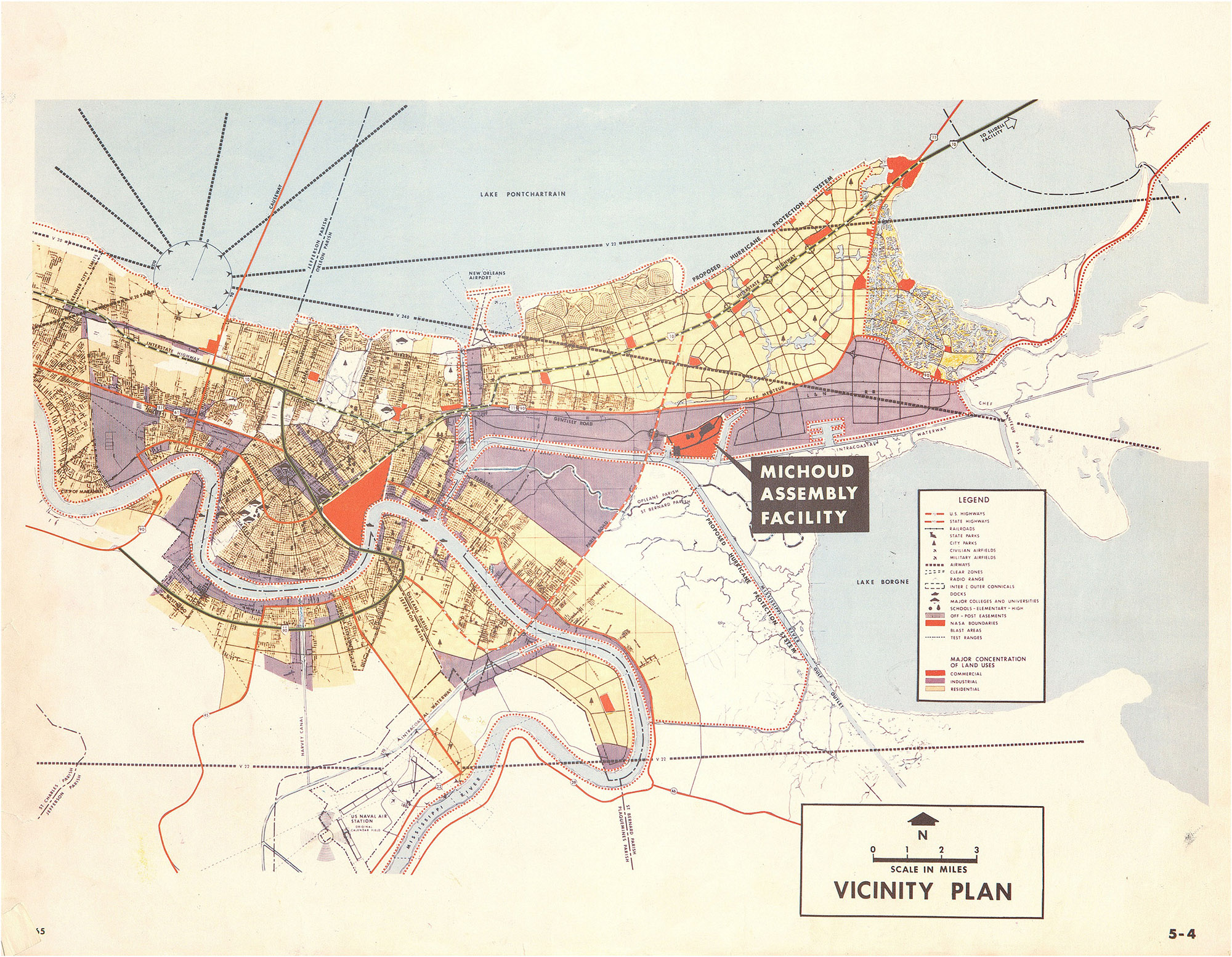
The vicinity plan was part of the original master plan for Michoud Assembly Facility published by NASA in 1966 and currently housed and digitized at LSU Libraries.
“Our job was to design a place that could assemble the future Nova rocket. They were working on the Saturn V rocket at the time, which got its name from its five engines, but it hadn’t been tested yet to fly with the engines inside. As it turned out, the engines were much more powerful than anyone had anticipated, and the Nova was supposed to be an even bigger rocket.”
“The Nova couldn’t be built on land. It had to be built on water and then floated to Florida via Mississippi Test Flight up in Picayune. You’ve heard of Stennis Space Center—that’s what it’s called now. To get there, you had to cross the new I-10 interstate highway with this huge barge with a rocket on top of it. That’s why that’s the only place in the interstate system that has a bridge. The interstate system is supposed to have clear access, no obstacles, because it’s a miliary road as well—it was built by Eisenhower after seeing the German autobahn. But the Nova was going to be so big, it couldn’t get under the road. They had to raise the bascule.”
“I remember when they tested just one Saturn V engine in Huntsville because everybody went for the event. What you can’t hear when you see a launch on TV is the real sound. It can’t be recorded because you can’t hear it. You can only feel it. It’s a low frequency that hammers you—it pounds your chest.”
Max Conrad
“After that test, I got a message that read, ‘Do not mention the Nova. It’s canceled.’ The Saturn was so strong, they realized they didn’t need the bigger Nova. But the bridge and the plan we’d worked on had already been made.”
“So, I designed a facility on water where they could assemble the rocket, put the pieces and different stages together, and stand it up. That required a special building, and it had to have a lock. You had to float the barge in and then drain the water out so the barge could settle down within the building. Then they’d flood it again to float the barge out. A standard lock—you go through a gate, the gate closes, and the water goes up and down—between the assembly building and the intracoastal canal.”
“Michoud was a truly giant factory. People who worked there had to run around on bicycles, it was so big. So, you had to have a road. You had to have parking. Simple stuff, but it had to be designed. And Michoud is in a very low area of New Orleans, so drainage was an issue. We needed to figure out how to get the water out.”
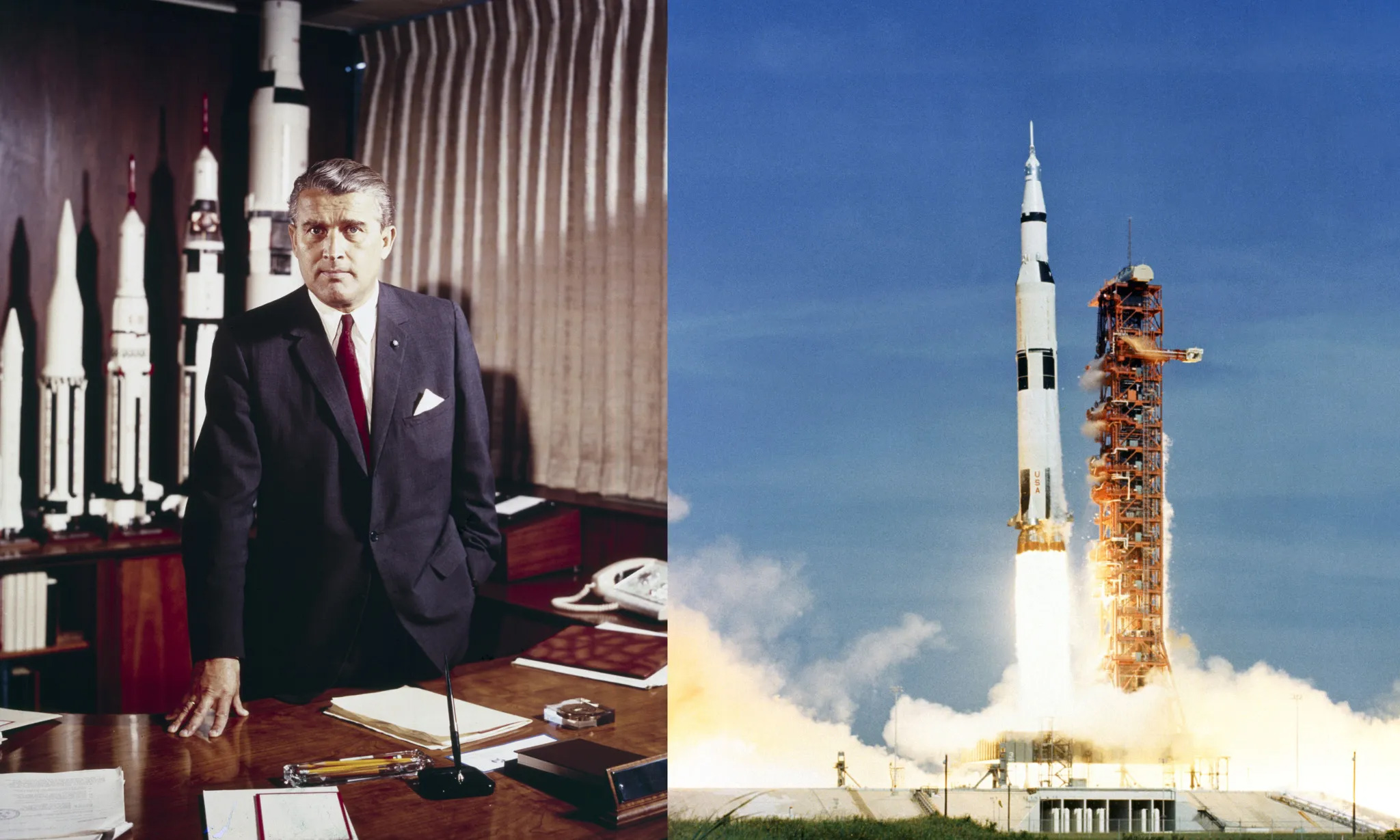
Wernher von Braun helped develop the Saturn family of rockets, which used liquid hydrogen as fuel in the upper stages. Originally proposed to launch military satellites, Saturn rockets were adopted as the launch vehicles for the Apollo Moon program. Three versions were built and flown: the medium-lift Saturn I, the heavy-lift Saturn IB, and the super-heavy-lift Saturn V. To date, the Saturn V is the only launch vehicle to transport human beings beyond low Earth orbit.
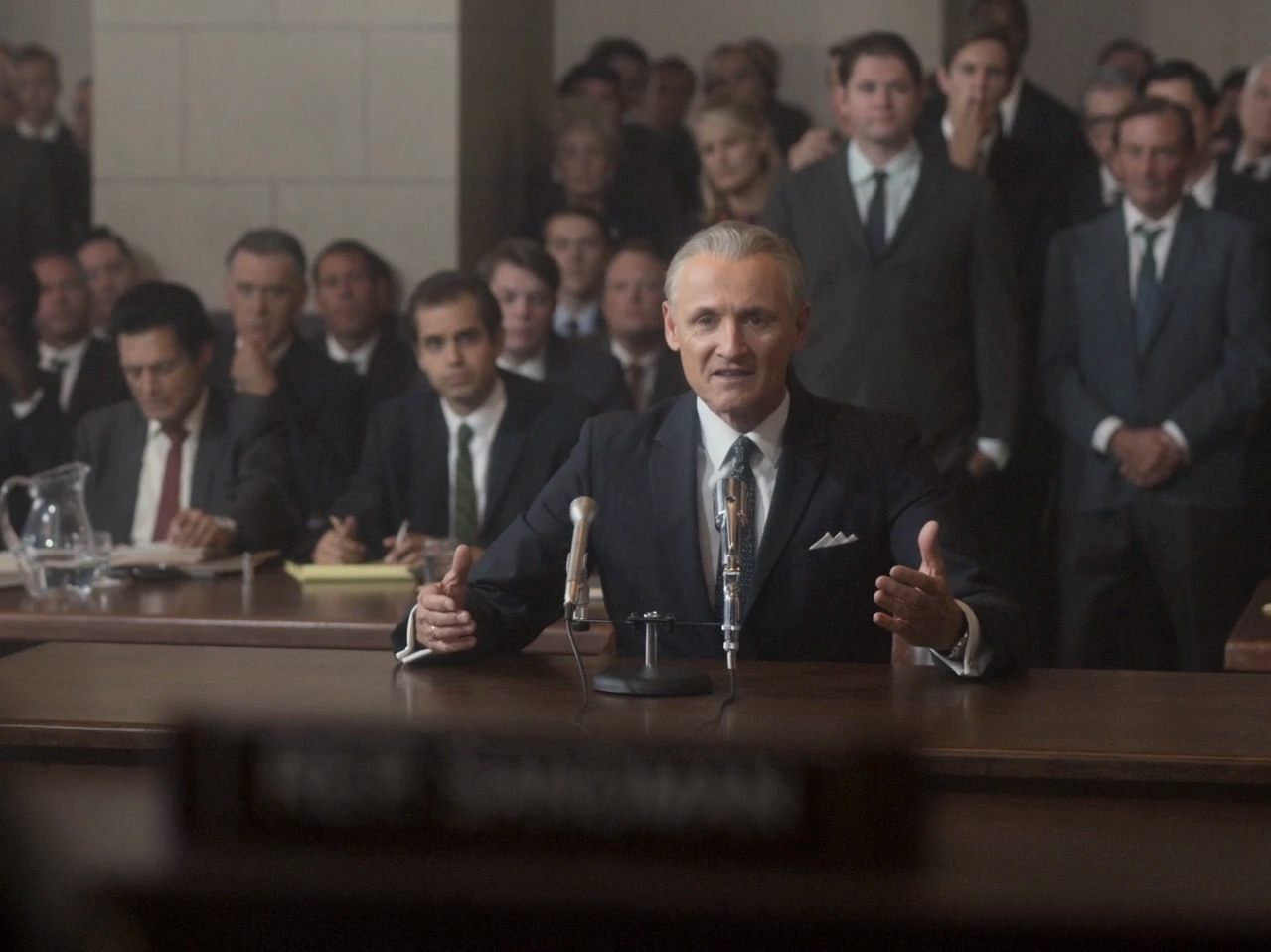
Wernher von Braun, played by Colm Feore, in the first season of the Apple TV series For All Mankind, which explores an alternate history where the Soviet space program wins the race to the Moon.
“That old runway they had for the World War II gliders led to an argument with von Braun, because he knew how to fly a plane. He would fly into the New Orleans Lakefront Airport, but then he looked at our plan and saw the runway and said, ‘Ahhh! I vill fly to Michoud!’ It became a big battle. We finally had to go meet with the Federal Aviation Administration to get the official no. It was obvious to us that he couldn’t use the runway. When you land a plane, you must have an approach that doesn’t have any obstacles on it, such as a high-level bridge to Chalmette! So, we had to get the FAA to convince von Braun he couldn’t fly into Michoud. But he was stubborn, fearless.”
“In Peenemünde, von Braun and Luehrsen were friends who double-dated together. To pick up Luehrsen, von Braun would land his plane in Luehrsen’s neighbor’s potato field and destroy part of the crop. The neighbor wasn’t happy, but that gives you an idea of what von Braun was like. But he was high up in society, so he did whatever he wanted. Well, we finally convinced him.”
Bananas
“One thing I knew how to make, or bake, was a banana cake. The Germans I worked with went crazy over it. I made it the way my mother made it, with yellow cake mix and fresh sliced bananas in the layers and just a little bit of icing to stick things together. No icing was on the outside. You use very ripe bananas because they have the most taste, and then you wrap it up in plastic wrap and put it in the refrigerator for a couple of days. With time, the banana permeates the cake, and the Germans went crazy over it. ‘Max! You must make the banana cake!’ They loved their coffee and cake.”
It is 1964. The second of two Mars flyby attempts by NASA returns the very first photos of another planet from deep space; launch of the IBM System/360 enables computing for both commercial and scientific applications, defining the basic unit of memory, the byte, as 8 bits.
Around the world in 285 days
“After the Michoud project, I really wanted to travel. That’s when I applied for the Charles Eliot Traveling Fellowship, and in early 1964, I won. I got $3,000 for travel in Europe for at least six weeks. I added my Huntsville savings and ended up traveling for nine and a half months. I circumnavigated the globe; I went everywhere.”
“Eventually, I started getting letters from NASA. ‘We want you to come back.’ I’d just said, ‘Adios!’ when I left, and didn’t want to go back to Hunt’s Patch. But I’d already stretched the money as far as I could—I was starving, and they offered me $13,000.”
“It was around that time I started getting offers from Dr. Reich to come teach at LSU, which I also had no desire in the world of doing at the time. All I wanted was to travel, but finally, I told Doc I’d come back for one spring semester to help, just temporarily. That was in 1966, and I’m still here.”