
Freedom from addiction: finding new treatments for devastating challenges
February 03, 2026
Dr. Ethan Anderson’s research zeroes in on the brain’s reward center, a structure called the nucleus accumbens. He studies how addiction reshapes this region, rewiring it to crave substances like alcohol or opioids. By seeking ways to reverse those changes, Anderson is working to discover therapies that could one day free those trapped in the cycle of dependence. Dr. Anderson, assistant professor in the Department of Comparative Biomedical Sciences, is focused on a molecular intervention which would reduce drug-seeking and drug-taking behaviors. With a new $2 million R01 grant from the National Institute on Alcohol and Alcohol Abuse (NIAAA), the Anderson Lab will be studying how epigenetic regulation in the nucleus accumbens alters alcohol drinking behavior.Dr. Anderson shares key aspects of his research.
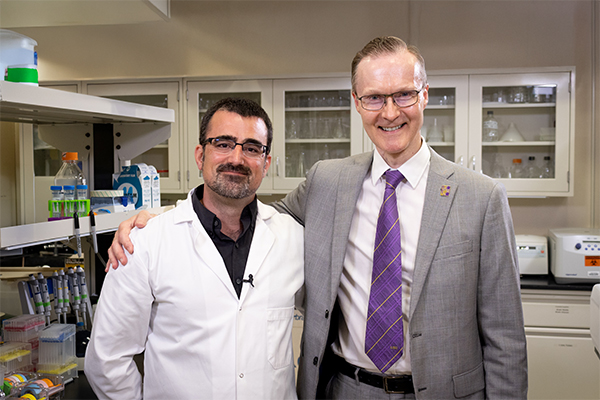
Ethan Anderson with LSU Vet Med Dean Oliver Garden.
Addiction destroys lives. One in 10 people have cravings for drugs or alcohol that they can't control. What happens in the brain when a person struggles with addiction is complicated. A lot of these substances over time rewire the brain through neuroplastic mechanisms, and they can lead to fundamental changes in the way that the nervous system reacts to stimuli. We understand some of the important brain areas involved in things like craving, but we don't really know the fundamental molecular mechanisms that are responsible. More importantly, we don't really know how to treat those things yet.
Drugs of abuse act on the body’s endogenous reward system. You have a reward system that is supposed to be able to respond to cues for things that we want. While you do want responses to cues for naturally rewarding things like water, good food, and companionship, drugs of abuse can take over this system, essentially hijacking it. Drug craving is similar to ravenous hunger or super intense thirst. So, evolutionarily, you want to go to things that are going to satiate your hunger and thirst cravings.
People have been using mind-altering substances for thousands and thousands of years. The diagnosis of addiction itself is a rather newer concept though. People have been studying the biggest problems first. For instance, based on findings from past scientific research, we can do things to bring somebody back from an overdose. We can also help to wean people off substances. But what we're still left with today is craving. We still don't quite understand how that works and how exactly to reduce those high levels of craving in people. We’re trying to take that next step to understand exactly what is changing in the brain in these reward-related regions.
Everyone knows people that suffer from addiction. I have members of my family—and I have known many people growing up—that have unfortunately had very difficult times with addiction. Being able to see those things firsthand initially made me very concerned, but also incredibly curious about how those things work. I originally planned to be a medical doctor and possibly go into psychiatry, but then as I learned more about the problem, I realized there was this big gap. We really can't treat things like cravings. That led me to this path, where I’d like to think that, in 10 years or so, we may have therapeutics that we can bring to the market to help treat people, control cravings, and get them back to a more normal life.